

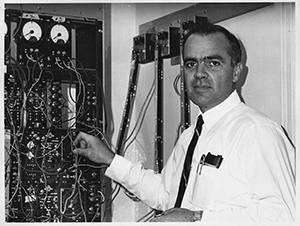
Dr. James C. Smith
In Memory
On Sunday 25 January 2026, the behavioral neuroscience field lost one of its most brilliant scholars and researchers with the passing of Dr. James C. Smith after a brief illness. He was born into a very modest household in Birmingham, AL on 27 December 1928. His mother passed away when he was 16 years old. His early life was far from easy, but he had fond memories of it nonetheless. He managed to eventually find his way to college at Auburn University, where he received his BS in Mathematics and Education in 1950.
Jim was admitted to graduate school in the Department of Psychology at the Florida State University. His intention was to pursue a career as a guidance counselor. But, as luck would have it, he took a course with the distinguished experimental psychologist, Winthrop Kellogg, and that set him on the path he was to follow for the rest of his professional life. In 1951, Jim earned his MS in Experimental Psychology. In 1952 he met the love of his life Elizabeth (Liz) Rose who, at the time, was a student at FSU. They were married in 1954 and soon after started a family. Liz was always there for him, rain or shine, and was part and parcel of his remarkable career.
After a 3-year stint as a first lieutenant in the United States Air Force, he returned to FSU where he taught and finished his graduate training, culminating with a PhD degree in Experimental Psychology in 1959. He was then hired as an Assistant Professor by the Department of Psychology at FSU but after a year, he decided to accept a position at Colgate University in Hamilton, NY. The northern climate didn’t suit Jim and Liz. So, after a couple of years, they decided to return to Tallahassee and Dr. Smith once again joined the FSU faculty as an Assistant Professor of Psychology, where he remained until he retired in 2003, rising through the ranks to eventually achieve the highest academic honor possible at the university as the recipient of the Robert O. Lawton Distinguished Professor Award in 1992.
Jim’s contributions to the experimental analysis of animal behavior were significant and refreshingly varied. He worked with animals from a wide range of taxa including moths, cockroaches, horseshoe crabs, turkey vultures, pigeons, a variety of mammals, and even an occasional human. He was revered as a leader in the area of animal psychophysics and was the principal architect of the conditioned suppression technique as applied to the psychophysical analysis of sensory function. His research resume included studies on insect vision, the immediate detection of x-rays, conditioned taste aversion, olfaction in birds (contrary to the claims of James Audubon), and detailed analyses of ingestive behavior.
In the prime of Dr. Smith’s career, the Florida State University was recognized as one of the few places in the world with a unique concentration of pioneers in the study of the chemical senses. He contributed significantly to that reputation. Scientists such as Lloyd Beidler, Don Tucker, and Pasquale Graziadei were in residence and Dr. Smith collaborated with them all, anchoring the behavioral analysis of chemosensory function at the institution, not to mention the influence he had on all of the students and postdocs who emanated from FSU and went on to establish fruitful careers in the area of taste and smell research. In fact, he was a founding member of the Association for Chemoreception Sciences (AChemS) – one of the world’s leading chemical senses research societies. That organization recognized his long-standing contributions to research on olfaction and gustation by choosing him as the 2004 recipient of the Max Mozell Outstanding Achievement Award in the Chemical Senses.
Dr. Smith and his students and coworkers helped to comprehensively characterize the phenomenon of taste aversion learning and, in the process, revealed some of its fundamental principles. In the study of eating and drinking, he was considered one of the world’s leading experts in the intricate analysis of meal patterns and he was constantly sought for collaboration even in his retirement. Late in his research career he and his colleague Tom Houpt conducted groundbreaking work on the behavioral consequences of exposure to magnetic fields. For his life-long contributions toward the understanding of the behavioral controls of food and fluid intake, Dr. Smith was the recipient of the 2002 Distinguished Career Award from the Society for the Study of Ingestive Behavior, the most significant honor this scientific group bestows. Like with AChemS, he was a member of the organizing committee for the foundation of this professional society.
Dr. Smith’s CV is replete with other honors and awards as well. In addition to those mentioned, he was a Fellow in Divisions 3 & 6 of the American Psychological Association as well as a Fellow in the American Psychological Society (now called the Association for Psychological Science). He was chosen as a National Sigma Xi Lecturer and, in 1994, was elected as a Fellow of the American Association for the Advancement of Science. At FSU, Dr. Smith was also the recipient of the University Distinguished Teacher Award in 1994 based on a lifetime of teaching excellence, and in 2005 the College of Arts and Sciences honored him as their Graduate of Distinction.
I know for a fact that, more than any award he ever won, any scientific discovery he ever made, any journal article he ever wrote, or any research grant he ever received, Dr. Smith always felt his most gratifying experience in academic science was training students and postdocs. Jim mentored 23 PhD students and 11 postdocs over his career. This is not to mention the numerous undergraduates who had the special privilege of taking classes with him. Dr. Smith’s lecture style was absolutely engaging. I remember how he would look into your eyes while he was lecturing as if to form a direct connection with the deepest recesses of your intellect. He would challenge students in class, but never intimidate. He had a way of instilling academic courage in students; they would dare to be wrong, and when they were, Jim would gracefully point them in the right direction. As for Jim's skills as a speaker, well, he could make a road map sound like a fascinating tale of intrigue and importance and all the while do it with a charming southern drawl. He was always able to bring out the natural wonder inherent in whatever scientific phenomenon he was discussing at the time. The man could spin a yarn and his joke-telling was legendary – you had to be patient, but once delivered, the punchline never disappointed and was always well worth the wait. He was a spellbinding orator, whether in the classroom, at a scientific conference, or just at a social gathering. Needless to say, he never had trouble with a course having an insufficient registration of students. Dr. Smith was singly the best teacher I have ever had or witnessed in my entire life and I am certain many others could make the same claim.
He was the model of the ideal academic scientist – uncompromising in his scientific standards, irresistibly drawn to his research, committed to his students, and dedicated to serving his discipline. He brought honor to his university and to his fields of study. His brilliance was only surpassed by his humility and generosity. Without exception, he was available to all when needed. He helped countless junior faculty at FSU find their footing. He saved many a befuddled student from an aimless trajectory. He offered honest counsel to university administrators and senior colleagues when called upon. Despite all of his accomplishments and the accolades they engendered, he remained a humble man.
With heartbreak, he endured the passing of his two sons Richard Clarke Smith shortly after birth and James (Jimbo) Smith in 2016, and his wife and life-partner Liz this past September. He is survived by his two daughters, Anne Smith Selvey (Tim) and Patricia Smith Willis (Ben); his daughter-in-law, Joy Hermanowski Smith; three grandchildren, James Daniel Smith (Camila), Matthew Charles Smith (Lucy), and Alexandra Rae Selvey; and his great-granddaughter, Charlotte Duke Smith. He will be dearly missed by his family, and his many former students, colleagues, and friends.
On a personal note, I am deeply grateful for all that Dr. Smith taught me and for his unyielding support throughout my adult life. On the day that I successfully defended my dissertation, he turned to me with this marvelously proud smile on his face and simply said, "Alan---call me Jim". I knew at that moment, the passion for science that Jim Smith inspired in me as a student would last forever. Since that day, I tried to refer to him as "Jim", but in my heart, he will always be "Dr. Smith", my venerable mentor.
-Alan Spector